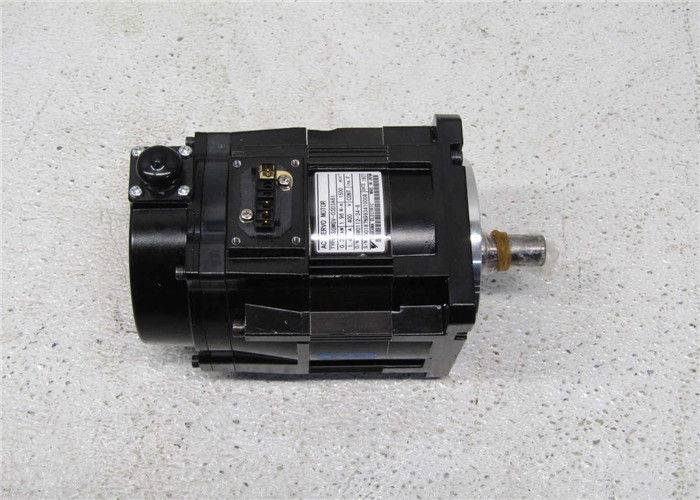
Yaskawa Servo Motor Industrial 1.96 Nm 300W SigmaV 1500RPM - Servo Motor SGMGV-03D3A61
Sigma II Amplifier Technology
Sigma II Amplifier is the ultimate servo solution for your automation needs. A single platform covers 30 watts to 55 kW and input voltages of 110, 230 and 480 VAC. The Sigma II amplifier can be set to torque, speed, or position control. A single-axis controller and a variety of network interface modules can be attached to the amplifier for the utmost flexibility. The Sigma II amplifier utilizes serial encoder technology to automatically recognize Sigma II rotary and linear servomotors.

Electrical Generator Technology Overview
The synchronous electrical generator (also called alternator) belongs to the family of electric rotating machines. Other members of the family are the direct-current (dc) motor or generator, the induction motor or generator, and a number of derivatives of all these three. What is common to all the members of this family is that the basic physical process involved in their operation is the conversion of electromagnetic energy to mechanical energy, and vice versa. Therefore, to comprehend the physical principles governing the operation of electric rotating machines, one has to understand some rudiments of electrical and mechanical engineering.
This content is written for those who are involved in operating, maintaining and trouble-shooting electrical generators, and who want to acquire a better understanding of the principles governing the machine's design and operation, but who do not have an electrical engineering background. The content starts by introducing the rudiments of electricity and magnetism, quickly building up to a description of the basic laws of physics governing the operation of the synchronous electric machine, which is the type of machine all turbogenerators belong to.
Magnets always have two poles: one called north; the other called south. Two north poles always repel each other, as do two south poles. However, north and south poles always attract each other. A magnetic field is defined as a physical field established between two poles. Its intensity and direction determine the forces of attraction or repulsion existing between the two magnets.
Typical representations show two interacting magnetic poles and the magnetic field established between them. Magnets are found in nature in all sorts of shapes and chemical constitution. Magnets used in industry are artificially made. Magnets that sustain their magnetism for long periods of time are denominated "permanent magnets." These are widely used in several types of electric rotating machines, including synchronous machines. However, due to mechanical, as well as operational reasons, permanent magnets in synchronous machines are restricted to those with ratings much lower than large turbine-driven generators, which is the subject of this content.
Turbine-driven generators (for short: turbogenerators) take advantage of the fact that magnetic fields can be created by the flow of electric currents in conductors.

 Your message must be between 20-3,000 characters!
Overall Rating
Rating Snapshot
The following is the distribution of all ratingsAll Reviews