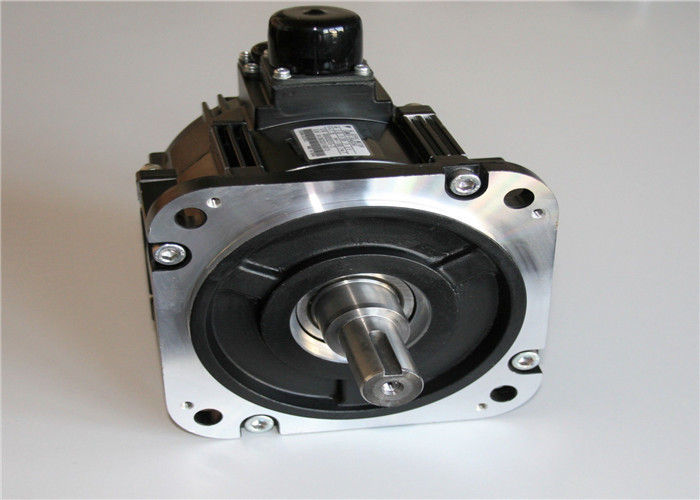
Yaskawa SGMGV 200V AC Servomotor with 850W Power and 17bit Absolute Encoder
Product Details:
Place of Origin:
Japan
Brand Name:
Yaskawa
Model Number:
SGMGV-09ADC6C
Detail Information
Place of Origin:
Japan
Brand Name:
Yaskawa
Model Number:
SGMGV-09ADC6C
Brand:
Yaskawa
Model:
SGMGV-09ADC6C
Type:
Servo Motor
Place Of Origin:
Japan
Current:
6.9A
Voltage:
200V
Power:
850W
Ins:
F
Highlight:
High Light
Highlight:
ac servo motor
,
electric servo motor
Trading Information
Minimum Order Quantity:
1
Price:
negotiable
Packaging Details:
New in original box
Delivery Time:
2-3 work days
Payment Terms:
T/T,Western Union
Supply Ability:
100
Product Description
Yaskawa SGMGV 200V AC Servomotor SGMGV-09ADC6C
Product Overview
New Industrial Servo Motor Yaskawa SGMGV 200V AC Servomotor SGMGV-09ADC6C delivers precision performance for industrial automation applications with reliable operation and advanced control capabilities.
Technical Specifications
Current
6.9A
Voltage
200V
Power
0.85KW
Rated Torque
5.39N-m
Max Speed
1500rpm
Encoder
17bit Absolute encoder
Load Inertia
0.026 kg·m² × 10⁻⁴
Shaft Type
Straight without key
Compatible Products & Brands
Yaskawa Motor, Driver SG-
Mitsubishi Motor HC-, HA-
Westinghouse Modules 1C-, 5X-
Emerson VE-, KJ-
Honeywell TC-, TK-
Fanuc motor A0-
Rosemount transmitter 3051-
Yokogawa transmitter EJA-
Contact Information
Contact Person: Anna
Email: wisdomlongkeji@163.com
Phone: +0086-13534205279
Similar Product Models
SGMGV-05ADA21
SGMGV-09ADA61
SGMGV-09ADC21
SGMGV-09ADC61
SGMGV-13ADA21
SGMGV-13ADA61
SGMGV-13ADA6C
SGMGV-1AADA61
SGMGV-20ADA21
SGMGV-20ADC61
SGMGV-30ADA21
SGMGV-30ADB6C
SGMGV-30ADC61
SGMGV-44ADA21
SGMGV-44ADA2C
About Electric Motors
The electric motor is fundamentally a converter of electrical energy to useful mechanical energy. Electric motors have played a leading role in the high productivity of modern industry and are directly responsible for the high standard of living enjoyed throughout the industrialized world.
The basic principles of electromagnetic induction were discovered in the early 1800s by Oersted, Gauss, and Faraday. In the late 1800s, Nikola Tesla invented the alternating current motor, revolutionizing industrial automation. Tesla's development of the versatile and rugged AC motor opened a new age of industrial productivity.
An electric motor operates on the principle that a current-carrying conductor placed in a magnetic field experiences a force proportional to the current and magnetic field strength. In AC motors, windings in the laminated stator core produce the magnetic field, while aluminum bars in the rotor core act as current-carrying conductors, resulting in rotary motion.
The most common motors today are alternating current induction motors, where power transfers from stator to rotor through electromagnetic induction without slip rings or brushes. The induction motor functions as a transformer with the stator winding as the primary and rotor bars as movable secondary members.